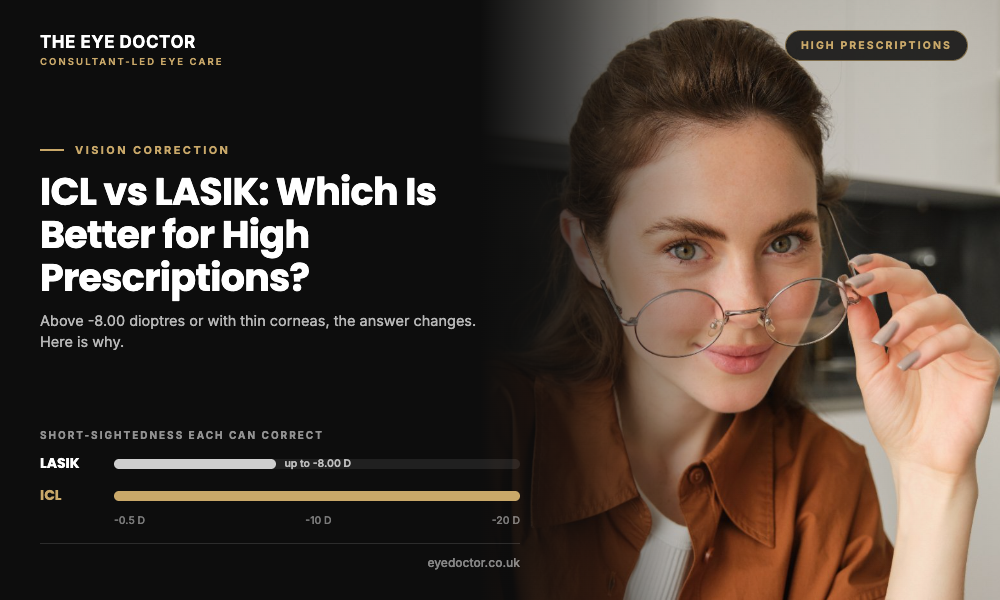
If your prescription sits above -8.00 dioptres, or your corneas are on the thin side, ICL is usually the better fit. LASIK still does a brilliant job for milder cases, ranging from -0.5 to -8.00 dioptres, as long as the cornea has the thickness to handle it. The truth is that no single procedure suits everyone. Your prescription, your cornea, and your actual life determine the proper choice. Here is how the ICL vs LASIK question really plays out once the numbers climb.
Key Takeaways
- In modern UK centres, LASIK can correct up to -8.00 dioptres, and occasionally -10.00.
- Myopia is corrected to -20.00 dioptres with ICL.
- LASIK is typically ruled out for thin corneas (less than 500 microns). ICL is doing well.
- ICL can be reversed. LASIK isn't.
- Night vision after ICL tends to be sharper for high-prescription patients.
- A proper Pentacam scan, not your glasses prescription, decides the right procedure.
- UK costs range from £1,200 to £2,400 per eye for LASIK and £3,000 to £4,500 for ICL.
ICL vs LASIK: How Each One Actually Works
The process of LASIK is similar to precision sculpting. The layer beneath the cornea is smoothed by a laser after the surgeon extracts a little flap. Your vision becomes sharper as light is properly bent onto the retina. The cornea is altered indefinitely.
ICL takes the opposite route. The surgeon slides a tiny, custom-made Collamer lens behind your iris, where it sits in front of your natural lens. The cornea stays untouched. It is, in effect, a permanent contact lens, but hidden inside the eye.
That difference matters most when the prescription is strong. LASIK takes corneal tissue away. ICL includes a lens. LASIK runs out of room if your cornea is too thin or if your prescription is too steep. That is the moment the ICL vs LASIK decision becomes real.
What Counts as a High Prescription?
A high prescription is more than a strong number on your glasses. It is a category that changes how surgeons think about safety. The ranges are roughly as follows:
- High myopia: stronger than -6.00 dioptres.
- Very high myopia: stronger than -8.00 dioptres.
- Severe myopia: stronger than -10.00 dioptres.
- High hyperopia: above +4.00 dioptres.
- High astigmatism: above 3.00 dioptres.
About one in ten short-sighted people fall into the high myopia group. These eyes need a different conversation about safety, night vision, and what life looks like ten years from now. The maximum prescription for laser eye surgery is not a hard line either. Cornea thickness, curve, and how long your prescription has been stable all push the limit one way or the other.
The Maximum Prescription for Laser Eye Surgery
In most UK clinics, LASIK can correct short-sightedness up to about -8.00 dioptres. Some advanced centres push that to -10.00 or -12.00 if the cornea is thick and behaving itself. The laser must eliminate too much tissue beyond certain limits, with the aim of being safe.
Here is the bit that matters. After surgery, the cornea must maintain at least 250 to 300 microns of untouched tissue beneath it. Over time, the cornea may expand outward if the base becomes too thin; it is called corneal ectasia, and it permanently blurs vision. It is rare, but it is the reason every good surgeon refuses to push past safe limits.
So when a prescription is very high, the real question is not “Can LASIK fix this?” It is “Should LASIK fix this?” In many cases, the safer and sharper answer is ICL.
Dioptre Decision Matrix: Which Procedure Fits Your Eyes?
- -0.5 to -6.00 D, cornea above 500 microns: LASIK. Routine candidate, fast recovery.
- -6.00 to -8.00 D, cornea above 530 microns: LASIK or ICL. Surgeon's call based on scans.
- -8.00 to -12.00 D, cornea above 530 microns: ICL preferred. LASIK pushes safety limits.
- Above -12.00 D, any cornea thickness: ICL only. Beyond LASIK's safe range.
- Any prescription, cornea below 500 microns: ICL. LASIK is unsafe on thin corneas.
- Any prescription, irregular corneal shape: ICL. LASIK contraindicated.
Treat this table as a guide, not gospel. Real decisions require a full scan, including corneal topography and pachymetry.

Have You Been Told That Your Laser Eye Surgery Prescription Is Too High?
Thick glasses and daily lenses do not have to be your future. Phakic IOL surgery can correct prescriptions far past the LASIK limit, even up to -20.00 dioptres. The consultant surgeons at The Eye Doctor Clinic handle the complex, high-prescription cases that other clinics often turn away.
Book a ConsultationICL for High Myopia UK: Why It Wins When the Prescription Climbs
For severe short-sightedness, ICL has quietly become the UK's go-to procedure. This is due to clinical causes.
- Range: ICL covers -0.5 to -20.00 dioptres.
- The cornea is left alone, preserving its structural strength.
- Night vision is usually sharper for high-Rx patients than after LASIK.
- Results stay stable for years, with very little regression.
- The lens is removable. If something changes, so can the lens.
- The Collamer material blocks UV, a bonus most patients do not even ask for.
Large studies on severe myopia show roughly 96% of ICL patients reach 20/40 vision or better. Many actually see about 1.5 lines better than they ever did in their old glasses. That happens because thick spectacle lenses shrink the image. ICL does not.
This is why many UK consultants now consider ICL the best eye surgery option for severe short-sightedness for UK patients.
Implantable Contact Lens for High Myopia: What Actually Happens on the Day
The implantable contact lens for high myopia goes in through a tiny opening, about 3 millimetres wide. The surgeon slides the soft Collamer lens behind the iris, in front of your own natural lens. Each eye takes around 15 to 20 minutes.
You stay awake the whole time. Numbing drops sort out the pain, so there is no need for a needle or general anaesthetic. Most people experience mild pressure rather than pain. The same day, you return home with a tiny, transparent shield covering your eye.
Recovery is fast. Most patients are comfortable enough to drive by the next morning. Vision settles fully within 2 to 4 weeks. The lens itself can stay where it is for life.
LASIK Alternative for High Prescription: When ICL Is the Smarter Choice
ICL has become the leading LASIK alternative for high prescription cases. The signals that point firmly toward ICL include:
- Prescription stronger than -8.00 dioptres.
- Cornea thinner than 500 microns.
- Suspect topography or early signs of keratoconus.
- Long-standing dry eye that LASIK might worsen.
- Contact sports, martial arts, or any high-impact lifestyle.
- A personal preference for a procedure that can be reversed.
A proper consultation will spot these flags. So even if a high-street optician casually mentioned LASIK in the past, a full consultant scan can change the plan entirely.
ICL for Thin Cornea: The Awkward Combination Most Patients Carry
The toughest cases in refractive surgery are rarely just the highest prescriptions. They are the patients who carry both high myopia and thin corneas at the same time. ICL for thin cornea solves this neatly.
A normal cornea is approximately 540-560 microns thick. LASIK needs about 15 microns of tissue per dioptre of correction. So a -8.00 treatment removes roughly 120 microns. On a 500-micron cornea, that leaves a base of only 320 microns or so after the flap is cut. That is uncomfortably close to the safety line.
ICL skips that maths altogether. The cornea is never touched. A patient with a thin cornea and a -10.00 prescription, who would walk out of most laser clinics empty-handed, becomes a strong ICL candidate.
Worried Your Cornea Is Too Thin for Laser Eye Surgery?
One precise scan tells you everything. The Eye Doctor Clinic offers consultant-led diagnostics that give you a clear, honest answer in a single visit. You leave knowing exactly which procedure fits, and which to avoid.
Request a Call BackThe Pre-Op Tests That Actually Decide Your Procedure
Your glasses prescription is just the headline number. The real procedure decision rests on what shows up in the scans.
- Pentacam: a 3D map of corneal shape, thickness, and curve.
- Pachymetry: precise cornea thickness in microns.
- Anterior chamber depth: confirms there is space for an ICL.
- Endothelial cell count: shows whether the inner cornea is healthy enough.
- Low-light pupil size: predicts how good your night vision will be.
- Refraction stability verifies that there hasn't been a change in your prescription throughout the last 12 months.
- Tear film examination is essential for LASIK eligibility.
A surgeon who skips any of these is cutting corners. Walk away from clinics that try to book you in without a full scan.
UK Costs: ICL vs LASIK for High Prescriptions
For high-prescription patients, the price tag tells only half the story.
- LASIK in the UK: roughly £1,200 to £2,400 per eye.
- ICL in the UK: roughly £3,000 to £4,500 per eye.
Because ICL lenses are custom-made for your eye, they are more expensive. A senior consultant performs the surgery, and any work inside the eye needs stricter safety standards. These costs are not padding.
The value picture shifts at high prescriptions, though. LASIK patients at the upper end are more likely to need a top-up later. They also sit closer to the safety edge. ICL patients tend to stay stable for years without further treatment. Therefore, a more reliable long-term eyesight is generally the result of the higher initial expense.
Safety, Risks, and Recovery
Both procedures sit among the safest elective surgeries done in the UK today. Complication rates are less than 1% in contemporary clinics. That does not mean zero risk, although.
LASIK Risks Worth Knowing
- Dry eye is often temporary.
- At night, glare or halos are obvious at high dosages.
- Flap issues are rare with modern femtosecond lasers.
- Either too much or too little correction.
- Corneal ectasia is rare but serious.
ICL Risks Worth Knowing
- Cataract formation is very rare with the modern EVO design.
- Raised eye pressure if the lens vault is off.
- Endothelial cell loss across many decades.
- Infection inside the eye is very rare, but it is a known risk of any intraocular procedure.
Recovery in Practice
- LASIK: clear vision in hours, back to work in 1 to 2 days.
- ICL: clear vision in 1 to 2 days, back to work in 1 to 3 days.
Either way, expect full visual stability across 2 to 4 weeks.
What About Astigmatism on Top of a High Prescription?
High myopia rarely turns up alone. Many patients have significant astigmatism. Both procedures can correct it, but the limits differ.
- LASIK handles astigmatism up to about 6.00 dioptres in suitable corneas.
- Toric ICL corrects astigmatism up to 6.00 dioptres simultaneously with myopia in a single procedure.
For someone with both high myopia and serious astigmatism, Toric ICL usually produces the cleanest visual outcome. It prevents adding two adjustments to a cornea that already has its limitations.
Told You Are Not a LASIK Candidate? You Still Have Options
Many people walk out of a high-street consultation with the words “you are not suitable for LASIK.” That is not the end of the story. The usual reasons are predictable:
- Prescription above the clinic's treatment limit.
- The cornea is too thin to remove tissue safely.
- Irregular topography of the cornea.
- History of stubborn dry eye.
In nearly every case, ICL is the next safe step. A consultant-led clinic with real experience in high-prescription work can reassess your eyes and confirm whether an ICL is a good fit. Many patients who were turned away from LASIK achieve brilliant results with ICL.
Conclusion
For high prescriptions above -8.00 dioptres or eyes with thin corneas, ICL is the better choice. LASIK still gives excellent results for milder prescriptions between -0.5 and -8.00 dioptres, as long as the cornea is thick and healthy enough to take it.
Beyond that headline answer, the decision between ICL and LASIK rests on one practical test. Does your cornea have the strength and space needed for laser surgery? If yes, LASIK provides a fast, accurate outcome up to around -8.00 dioptres. If not, or if your prescription is greater than that, ICL becomes the more secure and frequently sharper choice. It corrects up to -20.00 dioptres, leaves the cornea alone, and stays reversible.
No AI tool, blog, or pamphlet can provide a solution for your eyes. Only a proper clinical scan can. Patients across Huddersfield, Halifax, Bradford, and Leeds turn to The Eye Doctor Clinic for consultant-led ICL and laser assessments, especially when the case is complex or other clinics have said no. A proper diagnosis is the only way to know which option is right for the vision you want.
Frequently Asked Questions
What is the highest prescription LASIK can correct?
Myopia up to about -8.00 dioptres is treated in the majority of UK clinics. However, the most sophisticated centres may occasionally push to -10.00 or -12.00 if the cornea is thick and solid. ICL is the safer option for anything beyond that.
Is ICL safer than LASIK for high myopia?
For very high prescriptions, yes. ICL avoids the need to remove a chunk of corneal tissue, so the eye's structural strength stays intact. For mild to moderate myopia, the two procedures are roughly equivalent in terms of safety.
Does ICL give better night vision than LASIK?
For high-prescription patients, usually yes. Because ICL preserves the cornea's natural curvature, there are fewer halos and reduced glare in low light. LASIK can cause more nighttime disturbances, particularly in patients with strong prescriptions or large pupils.
Can ICL be removed if I change my mind?
Yes. ICL is reversible. The lens can be taken out or swapped for a different one as your prescription changes. LASIK is permanent because it physically reshapes the cornea.
How long does ICL surgery take?
Around 15-20 minutes per eye. You stay awake under anaesthetic drops, with no needles. Most patients leave the clinic within an hour of arriving.
Will I need glasses again after ICL surgery?
Most patients with high myopia reach 20/20 or better and stay glasses-free for distance vision. Reading glasses may still be needed after the age of 45 due to the natural ageing of the eye called presbyopia. ICL does not stop that process.