
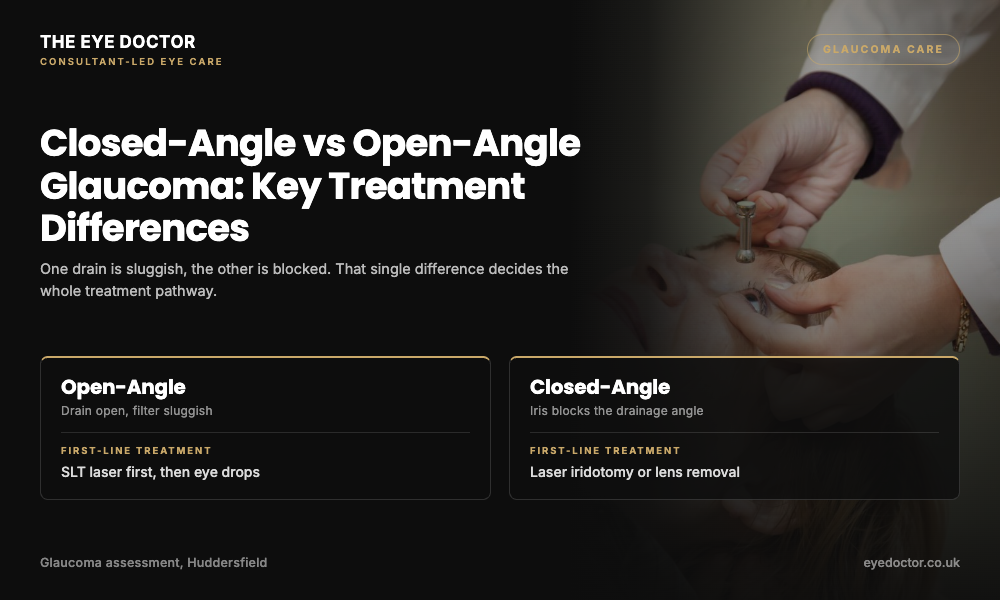
Open-angle glaucoma is usually treated with a laser or eye drops. Both slowly lower the pressure inside your eye. Closed-angle glaucoma needs something different. The drain is blocked, so it has to be opened. That means a tiny laser hole in the iris, or removal of the eye's natural lens.
The difference comes down to plumbing. In open-angle glaucoma, the drain is open but sluggish. In angle-closure glaucoma, the drainage angle is physically blocked. You cannot fix a blocked drain with a treatment built for a slow one, so the whole pathway changes.
Key Takeaways
- Open-angle glaucoma is slow and painless. Closed-angle glaucoma can be sudden and severe.
- Selective laser trabeculoplasty is usually the first treatment offered for open-angle glaucoma in the UK.
- Closed-angle glaucoma often needs laser peripheral iridotomy or lens removal instead.
- A sudden, severe red eye accompanied by blurred vision and illness is a medical emergency. Go to A&E or an eye casualty the same day.
- Only a test called gonioscopy can tell you which type you have.
- Sight already lost to glaucoma cannot come back, so early treatment matters.
Difference Between Open-Angle and Closed-Angle Glaucoma
Your eye makes a clear fluid called aqueous humour. That fluid drains away through a small channel where the coloured part of your eye meets the clear front window. This spot is the drainage angle.
In open-angle glaucoma, the angle stays open. So the drain looks fine. The trouble is further in, where the filter sits. Fluid gets out, just too slowly for the eye to keep up. Pressure builds. Over the years, that pressure wears down the optic nerve. And most people feel nothing while it happens.
Closed-angle glaucoma works differently. Here the iris shifts forward and covers the angle. The drain is blocked. Pressure can climb quickly, sometimes within hours.
That single difference, open drain versus blocked drain, decides everything else. It changes the symptoms, the urgency, and the treatment.
Open-Angle vs Closed-Angle Glaucoma at a Glance
- What goes wrong: Open-angle, drainage filter works poorly. Closed-angle, iris blocks the drainage angle.
- How fast it develops: Open-angle, slowly over years. Closed-angle, can be sudden or slow in chronic cases.
- Pain: Open-angle, none. Closed-angle, severe in acute attacks.
- Early symptoms: Open-angle, usually none. Closed-angle, sudden pain, halos, nausea, blurred sight.
- Vision loss pattern: Open-angle, side vision goes first. Closed-angle, sudden blur, then rapid loss.
- First-line treatment: Open-angle, laser trabeculoplasty, then drops. Closed-angle, laser iridotomy or lens removal.
- Urgency: Open-angle, planned care. Closed-angle, same-day emergency in acute attacks.
- How common in the UK: Open-angle, most common form. Closed-angle, less common but more dangerous when acute.
How Doctors Tell Which Type You Have
You cannot work this out from symptoms alone, and neither can an eye test that only checks pressure. Plenty of people with glaucoma have pressure readings that look normal.
The test that settles it is gonioscopy. A special mirrored lens sits gently on the front of your eye after the numbing drops are applied. The mirror allows the specialist to view the drainage angle. If the structures are visible, the angle is open. If they are hidden, the angle is narrow or closed.
Some clinics also use a scan called anterior segment OCT. It photographs the angle. Nothing touches your eye.
You will have a few other checks too. They'll take a pressure reading, scan the nerve at the back of your eye, and test your side vision. That last one matters because glaucoma takes side vision first. Put together, they show the specialist what one test alone cannot.

Not Sure Which Type of Glaucoma You Have?
Two people can have the same intraocular pressure and require completely different treatments. The only way to know yours is to have your drainage angle and optic nerve assessed properly in one appointment.
- Consultant ophthalmologists with a special interest in glaucoma
- A clear written plan you can take away
How Open-Angle Glaucoma Is Treated
For years, eye drops were the standard first step. That has changed.
Current NICE guidance recommends selective laser trabeculoplasty, or SLT, as the first treatment for most people newly diagnosed with open-angle glaucoma or raised eye pressure. The laser is gentle. It works on the drainage filter itself, helping fluid leave more easily.
Why the shift? A large UK trial is what changed it. People who started with SLT held their pressure at target more often, and without daily drops. That last part counts for a lot. Drops have to be remembered every day, for years on end, and most people slip at some point.
If laser is not enough
Drops come next. There are several families, and they either slow fluid production or help it drain. Your specialist picks one based on how low your pressure needs to go and how your eye responds.
If pressure stays too high, surgery is the next step:
- Minimally invasive glaucoma surgery. Tiny devices that improve outflow, often done at the same time as cataract surgery.
- Deep sclerectomy. Creates a new drainage route without a full opening into the eye.
- Trabeculectomy. The long-standing gold standard. A new drainage channel under the surface tissue.
- Tube surgery: a small implant that drains fluid, used in complex or advanced cases.
The aim throughout stays the same. Lower the pressure enough to slow damage. Nobody is trying to restore sight that has gone, because that is not possible.
How Closed-Angle Glaucoma Is Treated
The goal is to open the angle. Drops alone will not do that.
Laser peripheral iridotomy
This is the usual first step. A laser makes a tiny hole near the edge of the iris. Fluid can then pass through, and pressure behind the iris drops, so the iris falls back and uncovers the drain. It takes minutes and happens in a clinic.
It is also used before anything goes wrong. If a routine eye test reveals narrow angles, your optometrist may refer you for laser treatment as a precaution. That way, an acute attack never happens.
Lens removal
Your natural lens thickens as you get older. In a small eye, that thickening crowds the angle and pushes the iris forward. Take the lens out and replace it with a thin artificial one, and the angle opens up properly.
The EAGLE trial tested this against laser. For people over 50 with primary angle-closure, clear lens extraction provided better pressure control and quality of life. It is now a recognised first-line option in the UK, not just a last resort.
In an acute attack
An acute attack requires pressure to be brought down within hours. That means drops and tablets given in hospital first, then laser once the eye settles enough to treat. The other eye is usually treated too, because it carries the same risk.
Warning Signs You Should Not Wait On
Get seen the same day if you have:
- Sudden severe pain in or around one eye
- A red eye with blurred or foggy vision
- Rainbow rings or halos around lights
- Headache with sickness or vomiting
- A pupil that looks larger than usual and does not react
Go to your nearest eye casualty or A&E. If you are not sure where that is, ring NHS 111. Do not wait for a routine optician appointment, and do not wait until morning.
Worried Your Eye Pressure Is Not Under Control?
Stinging drops, missed doses, or readings that keep creeping up. If any of that sounds familiar, your current plan may not be right.
- Laser options that can reduce the need for daily drops
- Full pressure, nerve and visual field review in one visit
- Follow-up care with the same consultant, not a different face each time
Can One Type Turn Into the Other?
Not exactly, though the picture can change.
The two have separate causes, so open-angle glaucoma does not progress to closed-angle glaucoma. What can happen is that someone with open angles slowly develops narrow ones as they age and the lens thickens. Then a second problem sits on top of the first. This is called mixed-mechanism glaucoma, and it requires treatment for both.
That is one more reason for regular reviews. An angle that looked fine ten years ago may not look fine today.
Who Is Most at Risk
The risk profiles differ significantly, which surprises many people.
Open-angle glaucoma is more likely if you are over 40, have a family history, are short-sighted, have diabetes, or are of African or Caribbean heritage.
Closed-angle glaucoma is more likely if you are long-sighted, over 60, female, or of East Asian or South Asian heritage. Some medicines can also trigger an attack in people who already have narrow angles, so tell any new doctor if you have been told your angles are narrow.
Glaucoma UK reports that around 20 in every 5,000 people aged over 40 in the UK have primary angle-closure glaucoma. That rises to roughly 47 in every 5,000 once you pass 70.
Why Regular Eye Tests Still Matter Most
Open-angle glaucoma gives you no warning. By the time you notice a gap in your side vision, real damage has already happened. The nerve does not repair itself.
A free NHS sight test every two years picks up most cases early, and it is free if you are over 60 or have a close relative with glaucoma. If you have narrow angles, a preventative laser can stop an attack before it starts.
Treatment cannot restore what has been lost. It can protect what you still have, and it does that well when it starts early.
Conclusion
Open-angle glaucoma is treated with laser therapy or eye drops that gradually lower pressure. Closed-angle glaucoma requires opening the angle, usually with laser iridotomy or lens removal. The right treatment depends entirely on which type you have, and only a gonioscopy can tell you which type you have.
If you have been told your eye pressure is high, or if a family member has glaucoma, get your drainage angle properly assessed. The consultant team at The Eye Doctor in Huddersfield offer full glaucoma assessment and treatment for both types.
Frequently Asked Questions
Which is worse, open-angle or closed-angle glaucoma?
Neither is simply worse. Closed-angle glaucoma is more dangerous in the short term because an acute attack can damage sight within hours. Open-angle glaucoma causes more sight loss overall in the UK, purely because far more people have it and it goes unnoticed for so long.
Can open-angle glaucoma turn into closed-angle glaucoma?
Not directly. They have different causes. But angles do narrow with age, so that someone can develop both. Regular gonioscopy picks this up.
How do I know if I have narrow angles?
You will not feel them. An eye exam usually finds narrow angles, and an optometrist can refer you. If you have been told you have them, ask about preventive laser treatment.
Is laser iridotomy the same as SLT laser?
No, and they are not interchangeable. SLT treats the drainage filter and needs an open angle to work. Iridotomy makes a hole in the iris to unblock a closed angle. Using the wrong one would achieve nothing.
What is the first treatment for open-angle glaucoma in the UK?
For most people, it is now a laser, not drops. NICE advises offering anyone newly diagnosed selective laser trabeculoplasty, or SLT, as the first step. Drops come after, if the laser does not bring your pressure down enough.
How quickly can acute angle-closure glaucoma damage sight?
Permanent damage can begin within hours. This is why it counts as an emergency rather than an urgent appointment.
Does everyone with narrow angles need treatment?
No. Some people are watched rather than treated, especially if pressure is normal and there is no nerve damage. Your specialist decides based on the angle's narrowness and your other risk factors.