
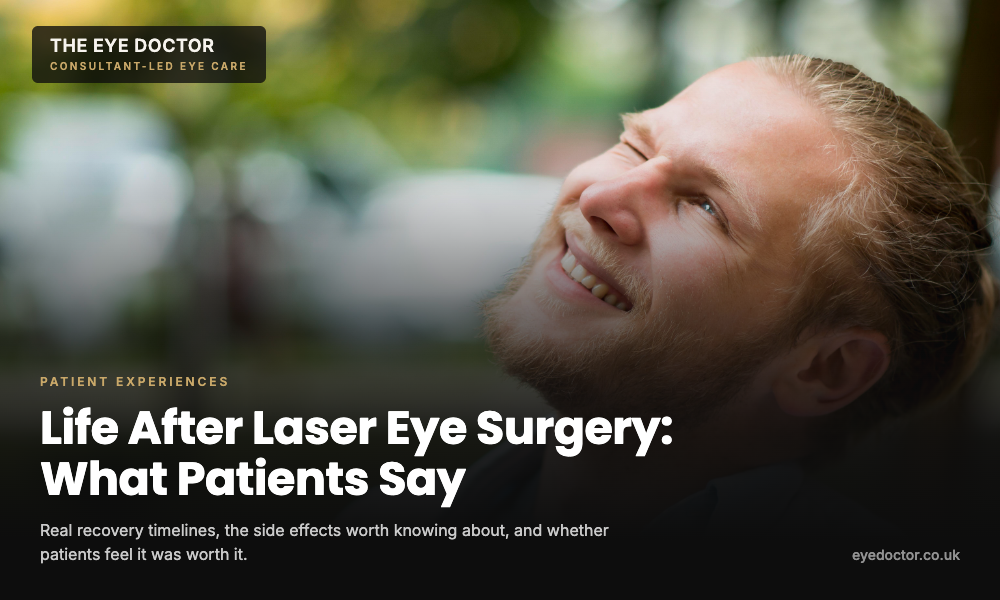
After undergoing laser eye surgery, one wakes up seeing more clearly and rarely needs to wear glasses. The first few days will yield better vision, with continuous improvement thereafter over the next few weeks. Activities become easier, and there is no need to clean or look for glasses before going to work.
But results and recovery are personal. Some eyes heal faster than others, and a small number of people still need glasses for certain tasks. This guide shows the real picture. It explains what patients say about recovery, side effects, and whether the treatment is worth it. It also reflects real patient reviews and before-and-after experiences, so you can set fair expectations before you book a consultation.
Key Takeaways
- Visual improvement is expected within 24 to 48 hours, while stabilisation takes several weeks.
- Less serious side effects, such as dry eyes and photophobia, are common but temporary.
- Complications are rare, but no eye procedure is entirely without risk.
- It will depend upon your eyes, your prescription, and an accurate evaluation.
What Does Life After Laser Eye Surgery Look Like?
Life after the procedure is mostly about being free of glasses and contact lenses. Many patients describe simple, everyday moments that feel new again.
Frequent changes discussed by patients include:
- Recognising their alarm clock sharply after waking up.
- Swimming, showering, and playing sports without using lenses or fogged glasses.
- Reduced fatigue while driving, recognising road signs and watching TV.
- Saving money over time on glasses, lenses, and cleaning solutions.
Laser eye surgery reshapes the clear front of the eye, called the cornea, so light focuses properly. It can correct short-sightedness (myopia), long-sightedness (hyperopia), and astigmatism. For most patients, the change is long-lasting. Even so, eyes still age naturally. Many people in their forties and beyond may still need reading glasses later in life, and cataracts can develop with age.
How Laser Eye Surgery Works
A quick recap helps explain why recovery feels so fast. The treatment is precise and takes only minutes per eye.
Here is the simple version:
- Numbing drops go in first, so the eye stays comfortable and no needles are used.
- For LASIK, a thin, protective flap is made on the cornea using a femtosecond laser.
- An excimer laser then reshapes the tissue underneath with great accuracy.
- The flap settles back into place naturally, with no stitches.
- Vision starts to clear within hours, then stabilises over the following weeks.
You can read the full step-by-step process on the laser vision correction page.
Laser Eye Surgery Recovery: The First Few Days
Laser eye surgery recovery is usually quick and comfortable, but the first 24 to 48 hours matter most. The eyes are healing, so a little care goes a long way.
What patients can expect early on:
- Mild stinging, watering, or a gritty feeling for a few hours after treatment.
- Blurry or hazy vision on the first day that sharpens quickly.
- Resting with the eyes closed for several hours, often with a short nap.
- A protective eye shield to wear while sleeping, to avoid rubbing.
- Prescribed drops to lower the risk of infection and ease dryness.

Tired of Reaching for Your Glasses the Moment You Wake Up?
- Consultant-led care from your first consultation to your final check.
- CQC-registered clinic with a team that has performed 20,000+ procedures.
Laser Eye Surgery Recovery Time: A Typical Timeline
Laser eye surgery recovery time varies from person to person, but it tends to follow a clear pattern. LASIK usually heals faster than LASEK, which works on the eye's surface.
A typical timeline looks like this:
- First 24 hours: Rest, mild irritation, and vision that is already improving.
- 24 to 48 hours: Many patients are back to driving once they meet the legal eyesight standard.
- First week: Most return to work and light daily tasks, while avoiding swimming and eye make-up.
- Two to four weeks: Vision continues to sharpen, and dryness usually settles.
- Within a few months: The cornea fully stabilises, and the final results become clear.
LASEK can take a few days longer to feel comfortable in the early stage, as the surface layer needs time to heal.
Laser Eye Surgery Side Effects: What to Expect After Laser Eye Surgery
Knowing about the side effects of laser eye surgery is part of making a safe choice. Most effects are mild and temporary, but it is fair to understand what to expect after laser eye surgery before you decide.
Common, short-term effects include:
- Dry eyes, which can last a few weeks or months, are eased with drops.
- Glare, halos, or starbursts around lights, especially when driving at night.
- Fluctuating or hazy vision while the eyes settle.
- Mild discomfort or watering in the first day or two.
Less common issues include under- or over-correction, which may require a small top-up treatment, and a rare risk of infection or flap complications. Serious complications are very rare and are estimated to occur in roughly 1 in 10,000 to 20,000 cases. Even so, no eye procedure is completely risk-free, and a small number of people still need glasses for some tasks. A thorough assessment lowers these risks by first checking that your eyes are suitable.
Worried About Side Effects, or Unsure If Laser Treatment Suits Your Eyes?
- Advanced diagnostics to measure your cornea and prescription.
- Honest advice, including other options if the laser is not right for you.
Laser Eye Surgery Options: LASIK, LASEK and Other Routes
Patients are not limited to one treatment. The right choice depends on the eye, the prescription, and the thickness of the cornea.
The main options include:
- LASIK: The most frequently used procedure, with a quick recovery period and good vision restored within 24 hours.
- LASEK: A surface treatment suitable for thin corneas, though it takes longer to heal.
- ICL (implantable contact lens): An option for higher prescriptions or thin corneas.
- Refractive lens exchange: Replaces the eye's natural lens and is suitable for older patients. You can read more about refractive lens exchange as an alternative.
A consultation is the only way to know which route is safest for each person.
Is Laser Eye Surgery Worth It? What Patients Say
Is laser eye surgery worth it? For most suitable patients, the honest answer from reviews is yes, but it depends on expectations. The treatment is elective and is not usually available on the NHS, so it is a personal decision.
Themes that come up again and again in patient feedback:
- Relief at no longer depending on glasses or contact lenses.
- Surprise at how quick and painless the procedure felt.
- Reassurance at being cared for by a named consultant from start to finish.
- A few honest notes about temporary dryness or night glare that eased with time.
Reviewing honest laser eye surgery reviews, including testimonials from people who underwent the procedure, will help form realistic expectations. High ratings and videos featuring the patient's experience prove that their story is genuine, rather than a single ideal outcome. The most unbiased opinion is that it is a truly life-changing procedure, provided it is suitable for you.
Conclusion
Living life after LASIK eye surgery is essentially a world of vision without spectacles for people who are suitable candidates for the procedure. This type of eye correction process involves speedy recovery, fewer side effects, and minimal complications.
If you are considering treatment, the experts at The Eye Doctor Clinic provide consultant-led laser vision correction in Huddersfield, with consultations in Leeds and treatment in Bolton. As a CQC-registered clinic rated 4.9 from more than 70 reviews, the team, led by founder Dr Fayyaz Musa, can assess your eyes and explain your options clearly.
Frequently Asked Questions
Is laser eye surgery worth it?
For most suitable patients, yes. Many people value the freedom from glasses and the quick recovery. However, it is elective surgery, so the decision should be based on a proper assessment of your eyes and prescription.
How long does laser eye surgery recovery take?
Most people notice clearer vision within 24 to 48 hours. Vision then continues to improve over a few weeks, with full corneal stabilisation usually achieved within a few months. LASEK can take a little longer than LASIK in the early stage.
What should I expect after laser eye surgery?
Mild burning, tearing, and blurred vision may occur on the first day. You'll have your eyes resting, wearing a shield at night, and administering prescribed eye drops. Daily activities can be resumed after one week, although swimming and applying eye makeup can still wait a while.
What are the most common side effects?
Dry eyes and glare or halos around lights are the most common. Both are usually temporary and ease as the eyes heal. Serious complications are very rare.
When can I drive after laser eye surgery?
Many patients can resume driving within 24 to 48 hours once their vision meets the legal eyesight standard. Your surgeon will confirm when it is safe at your follow-up check.
Will I ever need glasses again?
Results are long-lasting for most patients. Even so, eyes age naturally, so reading glasses may be needed later in life, and cataracts can still develop with age.