
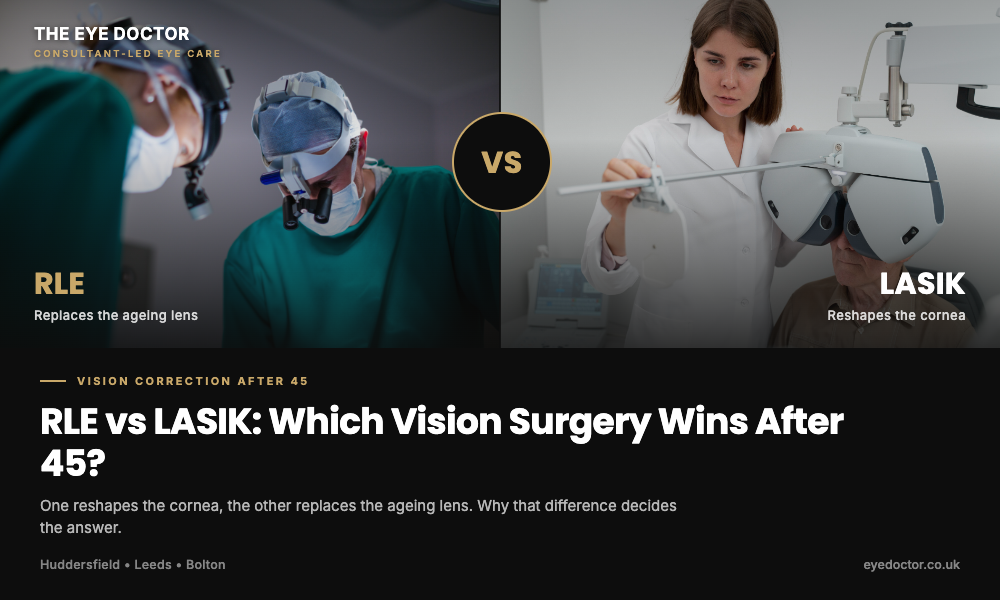
For those over 45, Refractive Lens Exchange (RLE) is the better alternative to LASIK. The answer lies in how these surgeries work. In individuals over 45, the natural lens hardens, causing presbyopia. While LASIK can correct vision problems by reshaping the cornea, it cannot prevent your lenses from ageing. RLE involves replacing your natural lens with an artificial lens, correcting near, intermediate, and distance vision at once. RLE also eliminates your risk of developing cataracts. However, LASIK is still recommended for those under 45 with healthy eyes.
Key Takeaways
- RLE replaces the ageing lens, so it corrects near, intermediate and distance vision in one step
- LASIK reshapes only the cornea, so it cannot stop the lens from hardening after 45
- RLE removes any future risk of cataracts; LASIK does not
- Monovision LASIK can help reading vision, but it reduces depth perception and night vision
- LASIK still suits younger patients with stable prescriptions and healthy corneas
What Is Refractive Lens Exchange (RLE)?
RLE, or lens replacement surgery (also called clear lens exchange), removes the eye's natural lens and replaces it with a precision intraocular lens (IOL). Surgeons use the same gentle technique as modern cataract surgery, but perform it before cataracts form. Each eye takes about 10 minutes and uses only numbing drops.
The implanted lens performs the focusing function that the natural lens used to. Premium options, such as Zeiss trifocal or toric IOLs, provide clear vision at multiple distances.
Key facts about RLE:
- Replaces the ageing lens with a permanent implant
- Treats short sight, long sight, astigmatism and presbyopia in one step
- Removes any future risk of cataracts forming
- Suits patients over 45 who want lasting freedom from glasses
What Is LASIK?
LASIK stands for Laser-Assisted In Situ Keratomileusis. During the LASIK procedure, the surgeon raises a thin corneal flap and uses a laser to reshape the underlying corneal tissue before placing the flap back into position. This causes light entering the eye to bend differently, so a sharp image falls on the retina.
LASIK works on the eye's surface, not inside it. It corrects short-sightedness, long-sightedness, and mild to moderate astigmatism. Recovery is fast, and most patients see well the day after surgery.
Key facts about LASIK:
- The cornea undergoes remodelling, while the lens does not
- Ideal for people aged between 20 and 45 years with a stable prescription
- Takes 24 to 48 hours for recovery in most cases
- Does not halt the hardening and opacity of the lens
How RLE and LASIK Work
Both procedures take only minutes, but they target very different parts of the eye.
How RLE works:
- Numbing drops settle the eye.
- The surgeon makes a tiny opening at the edge of the cornea.
- A gentle ultrasound breaks up the natural lens.
- The surgeon removes the lens and slides in a folded IOL.
- The implant unfolds and locks into position. No stitches needed.
How LASIK works:
- Eye-numbing drops calm the eye.
- A femtosecond laser produces a small layer in the cornea.
- The surgeon removes the layer to access the tissue under the cornea.
- An excimer laser reshapes the tissue to create the required curvature.
- Afterwards, the surgeon places the flap back into position.
Why Vision Changes After 45
The eye follows a predictable pattern of change from the mid-40s onwards. Knowing the cause helps you pick the right surgery.
- Presbyopia sets in. The natural lens hardens and loses focusing power.
- Reading glasses become a daily habit. Most people start propping them on their head or losing them around the house.
- Night vision drops. Driving at dusk and reading dashboards gets harder.
- Early cataracts can appear. From the mid-50s, the lens starts to cloud.
LASIK cannot fix any of these lens-based problems because it never touches the lens. RLE solves the root cause by replacing the lens entirely.
Lens Replacement Surgery vs Laser Eye Surgery: Side-by-Side for Over 45s
The lens replacement surgery vs laser eye surgery comparison comes down to five core differences for the over-45 group:
- Where surgeons treat: RLE works on the lens inside the eye. LASIK works on the corneal surface.
- Ageing fit: LASIK works best for people aged 20 to 45, while RLE suits those over 45.
- Treatment of presbyopia: Only RLE can permanently treat presbyopia, whereas LASIK cannot cure it.
- Prevention of cataracts: RLE permanently eliminates the risk of future cataracts, whereas LASIK cannot.
- Duration of the effects: RLE effects are permanent, whereas LASIK effects vary with age.

Tired of Juggling Reading, Distance and Varifocal Glasses?
- Consultant-led care from first scan to final discharge.
- Premium Zeiss trifocal and toric lens options.
- 20,000+ successful procedures performed by the team.
Laser Eye Surgery for Presbyopia: Does It Solve the Over-45 Problem?
Laser eye surgery for presbyopia becomes a choice for many individuals aged over 45 years in the quest for a solution that would address the issue permanently. The truth is that no surface laser can restore the lens's elasticity. LASIK would only help correct presbyopic problems through a procedure known as monovision.
Monovision involves adapting one eye to see far objects and the other to see near objects, allowing the brain to combine the two. Some find this easy, while others find it difficult, particularly when driving on the motorway.
This particular type of treatment option is only advisable for a certain type of individuals, as follows:
- Individuals aged between 40 and 50 years with a stable prescription
- Individuals who already wear monovision contact lenses comfortably
- Individuals who have not reached the level of requiring the entire lens surgery
For most patients over 45, lens-based surgery delivers a far broader range of clear vision.
Monovision LASIK Presbyopia: A Closer Look
Monovision LASIK is an appropriate corrective procedure for presbyopia, but patients should understand its drawbacks before choosing it. The non-dominant eye is slightly undercorrected by -1.25 to -1.75 dioptres, allowing this eye to focus on close objects.
The trade-offs:
- Depth perception drops slightly, which matters for golf, tennis and driving.
- Night vision halos and glare become more common.
- Up to one in five patients never adapt and ask for a reversal.
- The lens still ages beneath the surface, so reading vision drifts again within a few years.
Compared with monovision LASIK, RLE corrects both eyes, providing the full range of vision without sacrificing depth perception in either eye.
Clear Lens Exchange vs LASIK: The Permanent Difference
The clear lens exchange vs LASIK debate boils down to one point: only one procedure prevents the eye from ageing.
- Clear lens exchange (RLE): The surgeon replaces the natural lens. The artificial lens never clouds, stiffens, or develops cataracts.
- LASIK: The surgeon reshapes the cornea. The natural lens behind it continues to age. Presbyopia and cataracts can still appear later.
For a 47-year-old planning for the next 30 years, RLE is a permanent solution. LASIK can still serve a healthy 27-year-old with stable myopia, but it rarely fits the over-45 brief.
Worried You Might Pick the Wrong Surgery?
- Detailed corneal mapping, lens scans and retinal checks at one visit.
- Honest advice on whether LASIK, RLE or ICL fits your eye.
- Three months of inclusive consultant-led aftercare.
Best Eye Surgery Over 45: Treatment Options Compared
When choosing eye surgery for people over 45, the surgeon considers several important factors, including:
- Refractive Lens Exchange (RLE): First-line choice for most over-45s. Treats presbyopia and prevents cataracts.
- Cataract surgery with premium IOLs: Same technique as RLE, used once a cataract has already formed.
- LASIK: Suits a narrow group of healthy 45- to 50-year-olds with mild prescriptions and no presbyopia symptoms.
- LASEK or PRK: Surface laser alternatives for patients with thinner corneas.
- Implantable Collamer Lenses (ICL): Useful for very high prescriptions where LASIK is unsafe.
Lifestyle drives the final choice. Active people who play sports, drive at night, and read fine print usually benefit most from a multifocal RLE.
Risks, Candidacy and Recovery
Neither process carries a high risk of complications when performed by professionals. Learning about both options will help you decide.
RLE candidate and complications:
- Suitable for people above 45 years old with presbyopia and stable refractive error
- Not recommended for young individuals who have normal eyes
- Some possible complications include retinal detachment, infection, and posterior capsule opacification
- Most people learn how to drive within 24 hours
Candidacy for LASIK surgery and risks involved:
- Patients aged 20 to 45 years with stable prescriptions and healthy corneas are ideal candidates.
- It is not suitable for people with a thin cornea and dry eyes.
- Very rarely, side effects can be flap-related or include night halos and regression.
- Most people resume their regular activity within one or two days.
Conclusion
So, between RLE and LASIK, which is superior for people aged 45 and above? For most patients in this age bracket, Refractive Lens Exchange is the best choice, as it helps correct near, intermediate, and distance vision at once, minimises the risk of developing cataracts, and uses implants that do not wear out over time. However, LASIK is often better for younger people with stable prescriptions.
The right choice always depends on a proper consultant-led assessment, not a price list. The specialists at The Eye Doctor Clinic provide consultant-led Refractive Lens Exchange and Laser Eye Surgery in Huddersfield, Leeds and Bolton to help you achieve lasting freedom from glasses with confidence.
Frequently Asked Questions
Is LASIK suitable after 45?
There is no definite upper age limit for LASIK treatment. Still, after age 45, it is considered less viable because the lens becomes stiffer, and LASIK focuses only on reshaping the cornea.
Which is better for over-45s, RLE or LASIK?
Most individuals over 45 years old would be better off having RLE surgery done because it will fix their presbyopia condition and remove the possibility of developing cataracts in the future. In addition, LASIK works well only for some people between 45 and 50.
Can LASIK fix reading vision after 45?
The problem with LASIK is that it will not improve reading vision unless the patient uses the monovision approach, in which one eye sees distance and the other near. Although this procedure works for some people, it does reduce depth perception and night vision.
How long does RLE last compared with LASIK?
RLE effects last a lifetime, as the implanted lens never ages. LASIK effects remain strong for many years, while the patient's lens continues to age. Most patients who have LASIK will require reading glasses by age 45 and may develop cataracts.
Is RLE painful?
No. Surgeons use numbing drops, and most patients feel only mild pressure during the 10-minute procedure. Mild grittiness or watering for a day or two is normal during recovery.
How soon can I drive after RLE or LASIK?
Most LASIK patients drive the next day. Most RLE patients meet the legal driving standard within 24 to 48 hours. Your surgeon checks your vision before clearing you to drive.