

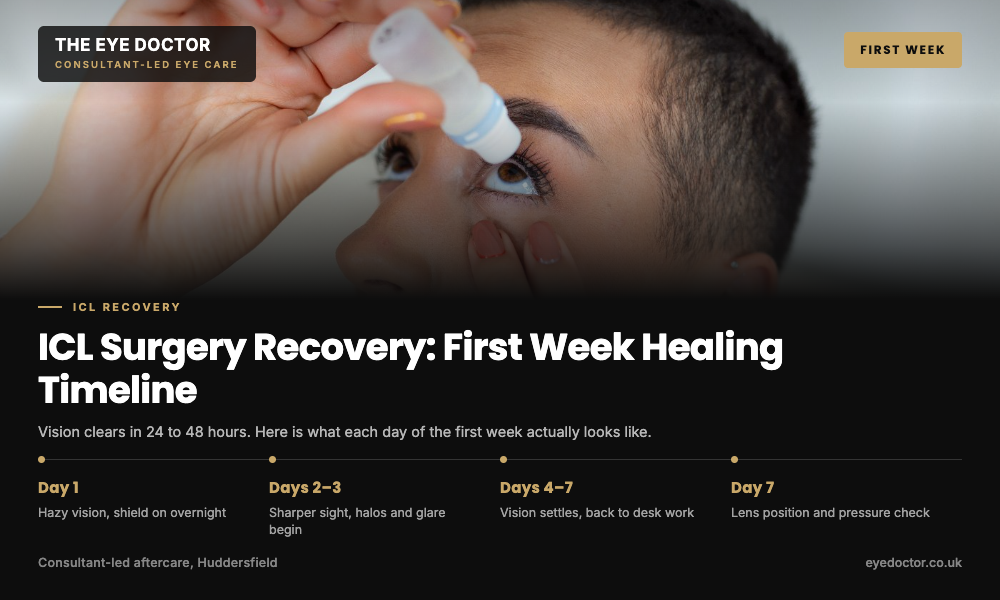
The first week of ICL surgery recovery is easier and faster than most would imagine. Vision clears in 24 to 48 hours. By the end of week one, daily chores are easy. Early signs are haziness and halos. Dryness can also occur. All of these go away as your eye heals.
Recovery is calmer than the surgery itself, which takes under 10 minutes per eye. The real healing happens in the days after. Your eye heals around the small cut. Your brain adjusts to the new lens inside your eye. Knowing what to expect makes the first 7 days feel calmer and easier.
Key Takeaways
- Most people see clearly within 48 hours, but full ICL surgery recovery takes 4 to 6 weeks.
- Halos, glare, blurry vision and dry eyes are normal in week one and fade as the eye heals.
- Use your drops on schedule, wear the shield for 7 nights, and avoid swimming and rubbing your eye.
- Call your surgeon the same day for severe pain, a sudden drop in vision, or thick discharge.
How Long Does ICL Surgery Recovery Take?
You can see clearly again within 48 hours of ICL surgery. About 9 in 10 patients reach this point. The full recovery from ICL surgery takes 4 to 6 weeks. But the first 7 days matter most. That's when the small cut on the eye heals, and the new lens settles into place.
The surgery itself takes only 5 to 7 minutes per eye. Recovery starts straight after. The lens used is the STAAR Surgical EVO Visian ICL. This is the standard lens for short-sightedness in UK eye clinics. NICE has approved it for use. A typical UK surgeon performs 6 to 8 ICL surgeries in a single morning.
Most people think of LASIK first for vision correction. But ICL is the better choice in two cases. The first is when the prescription is very strong (past -8). The second is when the cornea is too thin for laser treatment. Most ICL patients are between 21 and 45 years old. Their prescription must stay the same for at least 12 months before surgery.
ICL Surgery Recovery Timeline: Day by Day
Day 1: The First 24 Hours
The first day is hazy. After intraoperative drops, pupils remain dilated for approximately 4 hours, and the surroundings appear bright and washed out. When the protective shield is removed at the 9:00 review the next day, most patients show noticeably improved clarity compared with the night before.
Look, the first 24 hours are the toughest stretch. A mild ache or the sensation of an eyelash stuck in the eye is normal at this stage of recovery, and 1g of paracetamol every 6 hours is usually enough to manage discomfort for most patients through the first day. Sharp pain is not.
Day 1 ground rules:
- Sit in low light for the rest of the day after surgery
- Keep the plastic shield on through the night
- If you have pain, take 1g of paracetamol every 6 hours
- Arrange a lift home
Days 2 to 3: Early Healing
By 07:30 on Day 2, vision is sharper. Around 6 out of 10 patients meet the DVLA Group 1 standard at this point (20/40 acuity on the Snellen chart), though written clearance from the surgeon is the only signal that matters for actually getting behind the wheel. The eye feels a touch scratchy. That fades within hours of the first lubricant drop.
Brightness is the surprise. Sunlight off wet pavement at 8 am near Leeds Train Station can feel almost painful for some, which is why wraparound sunglasses help on the school run. Halos around streetlights typically start by Day 2 or Day 3. The brain is learning the new optics. Frustrating, but expected.
Days 4 to 7: Vision Settles
Your vision will feel better by the middle of the week. It will also be pleasant to work at the office and to read a book. Short laptop sessions will work, and watching TV at low brightness in the evening is safe.
The Week 1 check-up usually happens on Day 7. It takes about 25 minutes. The surgeon uses a special eye microscope to check the lens position. They also measure the pressure inside your eye. The lens should sit properly behind the colored part of the eye.
Lingering dryness is the main complaint at the Day 7 review. Around 1 in 3 patients still report a gritty feel for another fortnight or so before the tear film stabilises on its own. Preservative-free hyaluronate drops, often Hycosan Extra in UK pharmacies, sort this for nearly everyone. Dryness does not affect the final visual result.

Worried About the First Few Days After Your ICL Surgery?
Recovery feels much easier with consultant-led follow-up from start to finish. The Eye Doctor Clinic offers structured Day 1 and Day 7 check-ups, with direct access to your surgeon if anything feels off.
Book a ConsultationSymptoms You'll Notice in Week One
Blurry Vision After ICL Surgery
Blurry vision is the most common sign on Day 1 after ICL surgery. A few things cause it. The drops used during surgery keep your pupil wide for about 4 hours, so light scatters more. A thin layer of fluid sits on your eye overnight. Your brain is also still learning to work with the new lens. This usually clears within 24 to 72 hours.
A sudden drop in vision after Day 3 is not normal. Call your surgical team the same day. Sharp changes after 72 hours may indicate that the lens has moved or that eye pressure has increased. Both are rare, but both need quick action.
Halos and Glare After ICL
Halos and glare after ICL catch most patients off guard. The implant sits just behind the iris, and light scatters slightly around its edges when the pupil opens wide in the dark. Around the M62 at 9 pm, that scatter reads as starbursts off oncoming headlights. Most patients notice it strongly in the first 14 days. Then it fades.
Halos look like soft rings around bright points. Glare looks like spikes from them. Both fade with time. Patience is the only fix. Avoid driving at night during the first week after ICL surgery.
Dry Eyes After ICL Surgery
Dry eyes and discomfort after ICL surgery stem from the tear film, not the cornea itself. The 3mm temporal incision used in theatre briefly transects a small loop of corneal nerve endings, reducing blink-triggered tear release for about a fortnight, according to UK post-op data. The gritty feel that follows is short-lived.
Compared to LASIK, dryness is around a third as severe. Lubricant drops sort it. Hycosan Extra and Systane Ultra are the two common UK pharmacy choices for the first 2 weeks of ICL surgery recovery, both available without a prescription. After that, most patients drop the lubricant entirely.
Stuck on a Symptom That Won't Settle?
Halos at night. Dryness that lingers. Blurry moments that come and go. Most are part of normal ICL recovery. Some are not. The Eye Doctor Clinic helps you tell the difference, fast.
- Direct surgeon contact, same day
- Honest answers on what is normal and what needs review
- Tailored aftercare advice for your recovery
ICL Surgery Aftercare Instructions That Matter
Eye Drops after ICL Surgery
Eye drops after ICL surgery follow a schedule that slowly reduces. The surgeon plans it on the day of your surgery. You will get written instructions before you leave the recovery room. You will usually need three bottles.
- Maxidex (dexamethasone 0.1%): Anti-inflammatory. 4 times daily for 7 days, then 3 times for week 2, then twice for week 3, then once for week 4.
- Chloramphenicol 0.5%: Antibiotic. 4 times daily for the first 7 days. Stop after Day 7.
- Hycosan Extra or equivalent: Lubricant. As needed, often 4 to 6 times daily for the first fortnight.
A skipped dose is not the end of the world, but a skipped day might be, because the anti-inflammatory drops do the heavy lifting on early pressure control and the inflammation curve. Set a phone alarm at 09:00.
Sleeping Positions After ICL Surgery
How you sleep matters for the first 7 nights after ICL surgery. The goal is to keep pressure off your eye and avoid rubbing it in your sleep. People often turn toward the operated eye without realising it, especially in the middle of the night. Sleeping on your back is the safest way. You can sleep on your side if the operated eye is facing up and the shield stays on all night.
What helps:
- Plastic shield taped over the eye, every night, for 7 nights minimum
- Two pillows to keep the head slightly raised
- Pets and toddlers in a separate room (they brush faces in sleep)
- Drops within arm's reach for any 4 am dryness
Return to Work After ICL Surgery
Your job decides when you can go back to work. Office jobs are usually fine from Day 3 if you turn down your screen brightness to about 40%. Outdoor or dusty jobs need closer to 10 days. Lorry and taxi drivers need to pass a driving vision test before they can drive. This usually happens between Day 5 and Day 7.
A rough guide:
- Desk-based, no driving: Day 3 to Day 5
- Driving (DVLA Group 1): Day 5 to Day 7, after surgeon clearance
- Manual labour, dusty sites: Day 10 to Day 14
- Construction, sports coaching: 2 weeks minimum, with eye protection
- HGV (DVLA Group 2): Surgeon-confirmed only
Activities to Avoid in Week One
The avoid-list trips patients up. The temptation to return to normal is real. Swimming carries the biggest infection risk. The 3mm cut on the eye is still healing during the first 10 days. Pool water is the fastest way to get a serious eye infection after surgery.
Things to avoid in the first week:
- No swimming, hot tubs, or saunas
- No gardening or dusty work
- No eye makeup
- No rubbing your eye, even gently
- No contact sports
- No lifting anything over 5kg
Your surgeon will tell you which rules to stop first at your eye check. Some will stay in place until your 4-week visit. Stick to the list.
When to Call Your Eye Surgeon
A mild ache and trouble with bright light are normal until Day 4 or 5. Most mild soreness should be gone by then. But some signs need a same-day call to your surgeon, especially if they appear after Day 3.
Red flags:
- Severe pain that painkillers do not help
- A clear drop in vision after Day 2
- Very red eye with thick yellow or green fluid coming out
- Flashes of light or new spots in your vision
- A curtain or a shadow across your vision
- Light sensitivity that worsens rather than improves after Day 3
These signs point to a few possible causes. Infection is the first concern, especially with thick discharge. Next is a pressure spike from elevated intraocular pressure. Lens displacement, though it accounts for less than 1% of cases at well-run UK centres, remains firmly on the list for the first 7 days because catching it within hours protects long-term vision.
Conclusion
The first 7 days of ICL surgery recovery feel easier than they sound. Your vision gets better each day. The halos fade. The dryness goes away by Week 2. The hardest part is being patient. Night driving and long screen time are the toughest. You may feel tired by 4 pm on Day 5.
One question remains for the future. The lens may need to come out later in life. Some surgeons remove it during cataract surgery. Others wait until symptoms appear. Either way, the lens does come out one day.
For tailored guidance through the first 7 days, the consultant ophthalmologists at The Eye Doctor Clinic in Huddersfield run pre-op and post-op consultations across West Yorkshire.
Frequently Asked Questions
How long does blurry vision last after ICL surgery?
Most patients see clearly by 72 hours. Some mild blurriness can persist through Day 10 or 14. This is normal. Your brain is still getting used to the new lens inside your eye. But a sudden drop in vision after Day 3 is not normal. Call the surgeon the same day if this happens.
Can you wash your hair after ICL surgery?
Fine from Day 2. Tilt your head back over the sink, like a Yorkshire hairdresser would do a basin wash, until the Day 7 review confirms the cornea incision has closed. Showers are workable too, as long as you keep your head angled away from the spray for the first 7 days.
How long do halos last after ICL?
Halos peak early. The first 14 days after the EVO Visian ICL is implanted are the worst. By the 1-month mark, around 7 in 10 patients say they've noticed a noticeable improvement. By 3 months, the effect is minor or gone for most. Bigger pupils produce stronger halos, so someone with a 7mm dark-adapted pupil sees the effect longer than someone with a 5mm pupil.
Is ICL surgery recovery painful?
No, not really. Uncomfortable for a day or two for most. Severe or sharp pain is not normal. Call the surgical team the same day if it happens. Paracetamol helps with minor aches on Day 1 and Day 2. The NHS suggests 1g every 6 hours. By Day 3, even that fades for most.
Can you watch TV after ICL surgery?
Yes, from Day 1. The rule is the 20-20-20 rule: look 20 feet away for 20 seconds every 20 minutes. By the time the BBC News at Ten airs on Day 3, an hour of viewing feels fine for most.