
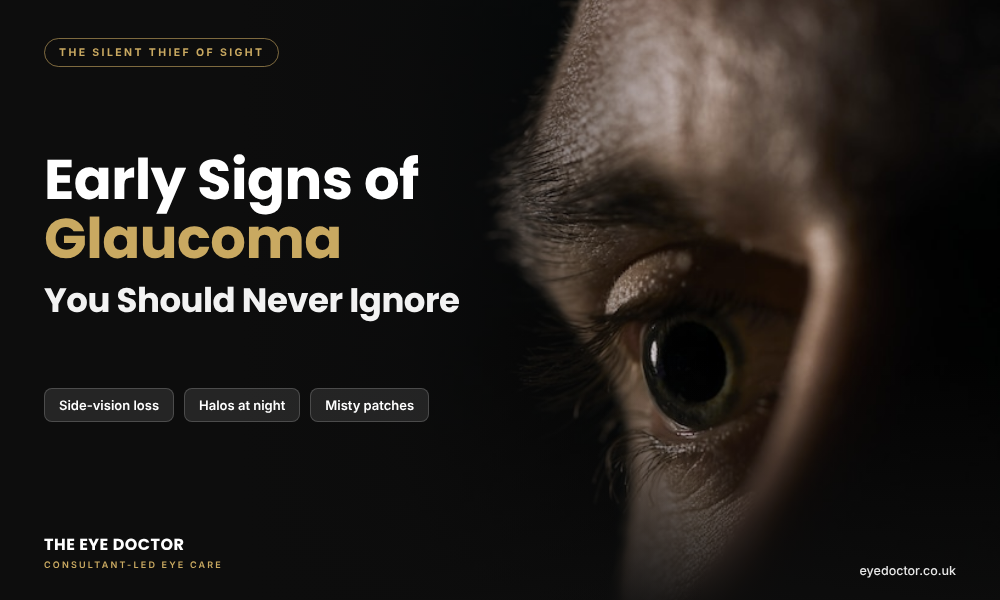
Early symptoms of glaucoma are loss of peripheral vision, blurred or misty patches, halos around lights, mild ache in the eye, and difficulty in night vision. Most types creep in over the years, so people often miss the change until some sight is already gone. That is why regular eye tests are important, even if your vision seems to be fine.
Key Takeaways
- Eye tests are really important. Glaucoma can develop without symptoms and can be detected early enough to treat before vision loss
- A gradual loss of peripheral vision is the most common first clue.
- Sudden eye pain, redness, and sickness can point to angle closure glaucoma.
- Adults over 40, those with a family history, and people of African or Asian heritage face a higher risk.
- A simple glaucoma test at the optician's can catch the problem years before sight loss starts.
What Are the Early Signs of Glaucoma?
Glaucoma earns its nickname, the silent thief of sight, because the most common form gives almost no warning. Damage to the optic nerve grows over the years. By the time symptoms feel obvious, a fair amount of sight is often already gone.
The earliest clues to look out for include:
- Slow loss of side vision (peripheral vision)
- Spots of blurriness or haze in your field of vision
- Rings around lights at night (rainbow, halos)
- Mild ache around the eyes or forehead
- Trouble adjusting to dim rooms or low light
- More glare than usual when you drive at night
- Need for brighter light to read or sew.
These signs can feel small or like a normal part of age. So a routine eye test remains the safest way to catch them. If two or three of these clues apply to you, book a test sooner rather than later.
What Does Glaucoma Vision Look Like?
Many people picture a black tunnel when they think of glaucoma. That image is not right. Real glaucoma sight loss looks more like soft, misty patches in your field of view. If you close one eye, you may notice a faint, blurry spot near the edge.
The misty patches start at the sides of what you see. Over the years, they slowly move towards the middle. Your straight-ahead vision stays sharp for a long time, so many people do not spot any change. The brain fills in the gaps with help from your other eye. Daily life feels normal even when the optic nerve is already hurt.
Some people also notice these subtle shifts:
- Colours look duller, mostly blues and yellows.
- Lights feel harsher than they used to
- Step edges, curbs, and stairs feel harder to judge.
- You bump into door frames or miss objects to one side.
Glaucoma Risk Factors: Are You at Higher Risk?
Anyone can develop glaucoma, but some groups face a much higher chance. The main glaucoma risk factors include:
- Age over 40, with a sharp rise after 60
- A close blood relative with glaucoma (parent, sibling or child)
- African, Afro-Caribbean, or East Asian heritage
- High short-sight (myopia) or high long-sight (hyperopia)
- Long-term use of steroid eye drops or steroid tablets
- Past eye injury or eye surgery
- Diabetes or high blood pressure
- Thin corneas, which often turn up on a routine eye test
If two or more apply to you, a yearly eye test is wise. The NHS offers free eye tests for over-60s, and for over-40s with a parent, brother or sister who has glaucoma. People with diabetes also get free retinal screening each year.

Are you worried about your risk of sight loss?
Caught early, glaucoma need not steal your vision. The consultant team at The Eye Doctor Clinic in Huddersfield use a Zeiss Forum diagnostic platform to spot subtle nerve changes years before symptoms start.
- Consultant-led care on every case
- Full glaucoma report on the day
- Trusted by opticians across Huddersfield, Halifax, Bradford and Leeds
Angle Closure Glaucoma Symptoms: When to Act Fast
Glaucoma usually develops gradually. In angle closure glaucoma, the reverse is true. The drainage angle in the eye suddenly gets blocked. Pressure grows in hours. The eye requires urgent treatment, often on the same day, to save sight.
The symptoms come on fast and feel nothing like a normal sore eye:
- A sharp, deep pain in one eye that gets worse over an hour or two
- The eye looks bloodshot and feels rock-hard to the touch
- You feel sick, or are actually sick
- Blurred vision with rainbow rings around any light
- A severe headache on the same side as the painful eye
- A pupil that does not react to light
Sometimes a milder attack comes on in the evening and clears overnight. Do not ignore it. These sub-acute attacks often warn of a full attack to come. Anyone with these signs needs same-day medical help, either at A&E or through an urgent eye clinic. Sight loss from an untreated attack can become permanent in a day or two.
Peripheral Vision Loss Causes Explained
Peripheral vision loss is the most common early clue to glaucoma. But it has other causes too. The main reasons your side vision may shrink include:
- Glaucoma: slow nerve damage from raised eye pressure
- Retinitis pigmentosa: a rare inherited retinal disease
- A stroke that hits the visual cortex at the back of the brain
- Detached retina
- Optic neuritis or direct optic nerve injury
- A brain tumour that presses on the visual pathway
In adults over 40, glaucoma is by far the most common reason.
A full eye test sorts out which cause is to blame. If your peripheral vision feels off or you keep bumping into things, do not put it off. A quick test can rule out the urgent causes and confirm the next step.
The Role of a Glaucoma Test at Opticians
A glaucoma test at the opticians is the front line of UK eye care. Most cases get picked up here first, then sent on to a hospital eye specialist. The full check takes about 30 minutes and looks at four key things:
- Eye pressure check (tonometry): A puff of air, or a small probe, measures the pressure inside your eye.
- Optic nerve scan (OCT): A safe light scan takes 3D pictures of the optic nerve. It can spot early damage that you would not notice yourself.
- Visual field test: You press a button every time you see a flash of light in your peripheral vision. If you see missed flashes, it means you have holes in your peripheral vision.
- Dilated eye exam: Drops widen your pupils so the optic nerve is easier to see. Vision stays blurry for a few hours, so bring sunglasses and skip the drive home.
How often should you book a test?
- Every two years for adults with no risk factors
- Yearly for adults over 60 or with a family history of glaucoma
- Yearly for people with diabetes (via free NHS retinal screening)
If anything looks off, the optometrist refers the patient to a hospital eye service or a private consultant for further checks. A referral does not mean you have glaucoma. It just means more detailed tests are needed.
Feeling sudden Eye Pain or a change in Sight?
Angle closure attacks and fast-onset symptoms need urgent specialist care. The senior consultants at The Eye Doctor Clinic in Huddersfield handle complex and acute glaucoma cases that high-street clinics often refer on.
- Same-day urgent slots for acute cases
- On-site general anaesthetic theatre
- Full surgical pathway under one roof
How Glaucoma Is Diagnosed in a Specialist Clinic
If a routine eye test flags a concern, a glaucoma specialist runs more detailed checks. Modern diagnostic suites aggregate data from multiple tests into a single report. The Zeiss Forum platform, for example, links OCT scans, visual fields, and corneal thickness data so that small changes are detected early.
Tests at this stage may include:
- High-resolution OCT of the optic nerve and retinal nerve fibre layer
- Pachymetry to measure corneal thickness (thin corneas raise risk and can fool pressure readings)
- Gonioscopy: A special contact lens lets the doctor look at the drainage angle in your eye
- Repeat visual field tests, spaced a few months apart, to check whether your side vision is holding steady
Once the specialist has all of this in front of them, the next step usually falls into place: treatment, yes or no, and which kind. There's a second benefit, too. All of these readings become your baseline, so any shift further down the line is easy to catch.
Treatment Options if Glaucoma Is Found
Treatment starts at the lowest level of severity and moves up only if needed. The main options, in order of strength, are:
- Eye drops: first line for most cases; lower eye pressure each day.
- Selective Laser Trabeculoplasty (SLT): a brief laser treatment that helps fluid drain. Many people avoid surgery this way.
- Deep Sclerectomy: a non-penetrating surgery that creates a new drainage path.
- Trabeculectomy: the gold standard surgery for advanced cases.
- Tube Surgery: uses a tiny tube to control pressure in complex or repeat cases.
The right choice depends on the type of glaucoma, how far it has progressed, the eye pressure level and your general health. The aim is always the smallest step that protects your sight.
Conclusion
Glaucoma earns its nickname, the silent thief, for good reason. The early signs of glaucoma, soft sight loss at the sides, halos at night and mild aches, creep in over the years. A sudden sharp pain usually points to angle closure and needs same-day care. Your risk goes up with age, family history and certain health conditions, so regular eye tests are the best protection.
If your optician has referred you or you wish to take charge of your long-term eye health, the team at The Eye Doctor clinic in Huddersfield offers consultant-led glaucoma assessment.
Frequently Asked Questions
Can glaucoma be cured?
No, glaucoma cannot be cured. But early treatment with drops, laser, or surgery can slow or stop sight loss in most cases. The damage already done cannot be reversed, which is why early detection matters so much.
Is glaucoma hereditary?
Yes, glaucoma runs in families. If a parent, brother or sister has it, your risk is around 4 to 9 times higher than for someone with no family link. Tell your optometrist about any family history at every test.
How quickly does glaucoma progress?
Glaucoma usually progresses slowly. The most common type, open-angle, may not cause any real damage for decades, and it can be kept under control with drops or laser treatment. Angle closure is different. Pressure can skyrocket in hours, so sudden eye pain or blurred vision needs same-day attention.
How often should I get my eyes tested for glaucoma in the UK?
Every two years, adults with no risk factors. Yearly, if you are over 60, have a family history of glaucoma, or have diabetes.
Does glaucoma always lead to blindness?
No. With early detection and steady treatment, most people keep useful sight for life. Late diagnosis is the main reason for severe sight loss, not glaucoma itself.
Are eye tests for glaucoma free on the NHS?
Yes, eye tests are free for over-60s, for over-40s with a direct family history of glaucoma, for people with diabetes and for those already diagnosed with glaucoma.